Peptide Therapy

You know what you want to change. What’s harder is knowing which approach actually makes sense for your body. Peptide therapy starts with that question, not with whichever molecule is making headlines.

You know what you want to change. What’s harder is knowing which approach actually makes sense for your body. Peptide therapy starts with that question, not with whichever molecule is making headlines.

Supports the body's own signaling

Supports metabolic health

Used within a supervised protocol

Part of a supervised plan

Supports energy and recovery

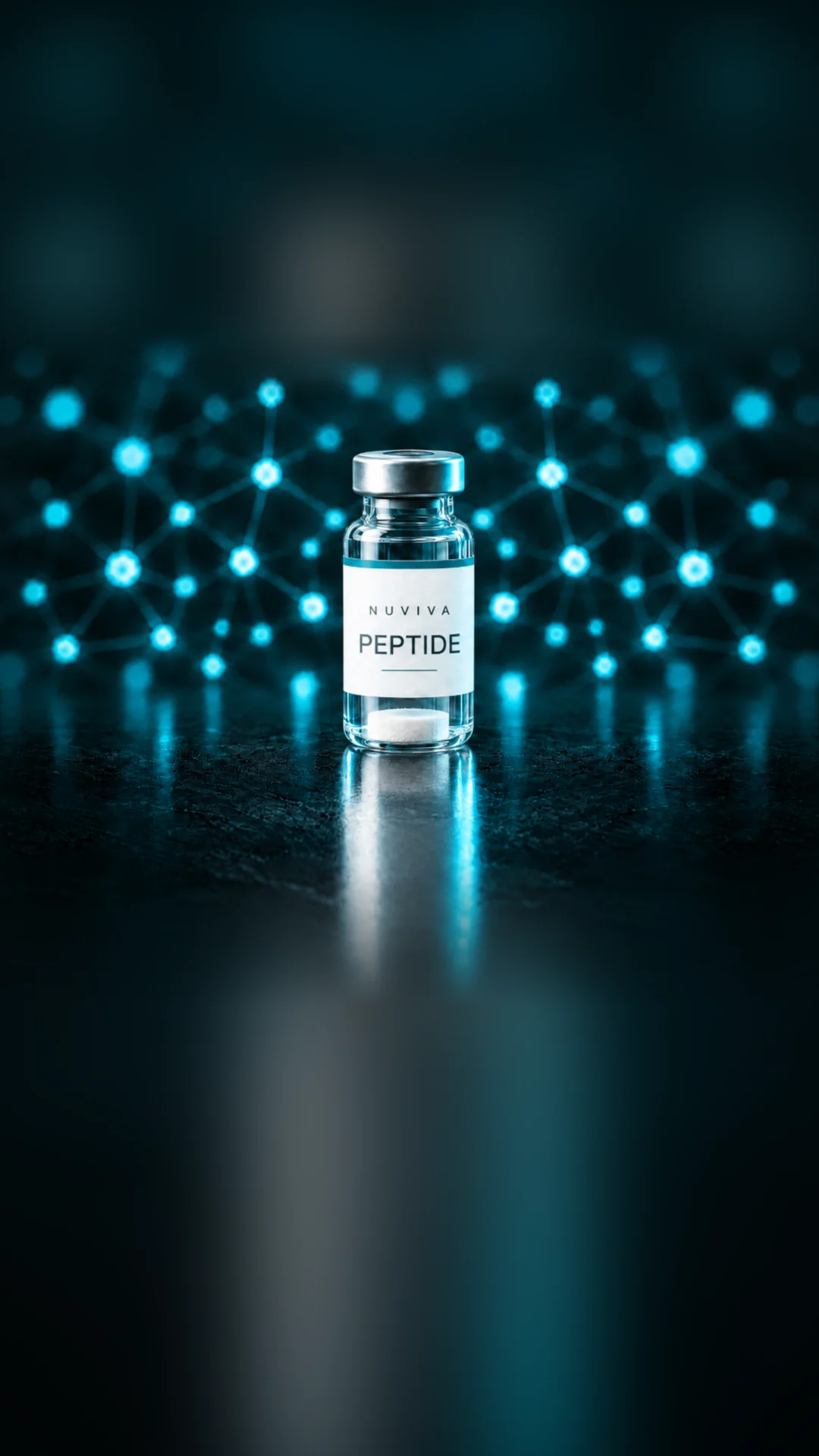
Nuviva vial labeled Peptide against a glowing teal network background
Nuviva vial labeled Peptide on a dark reflective surface with a teal glow
  • Medically Directed Care

  • Licensed Provider Evaluation

  • Ongoing Clinical Review

  • Free Consultation

Maybe you used to bounce back faster. A hard workout did not seem to follow you around for days. Energy felt more predictable. Changing your body composition felt more responsive to effort. Your body simply seemed easier to work with. Now something feels different.

Maybe you used to bounce back faster. A hard workout did not seem to follow you around for days. Energy felt more predictable. Changing your body composition felt more responsive to effort. Your body simply seemed easier to work with. Now something feels different.

So you start searching. Recovery. Metabolism. Body composition. Performance. Energy. Healthy aging. Eventually, you land on peptides. Then things get confusing fast. One compound is discussed for recovery. Another for metabolism. Another for body composition. Sometimes the same molecule seems to be marketed for five different outcomes at once.

So you start searching. Recovery. Metabolism. Body composition. Performance. Energy. Healthy aging. Eventually, you land on peptides. Then things get confusing fast. One compound is discussed for recovery. Another for metabolism. Another for body composition. Sometimes the same molecule seems to be marketed for five different outcomes at once.

That is why Nuviva starts somewhere else. Not with the molecule. With you. What changed? What are you trying to improve? What have you already tried? What does your health history look like? And does a peptide-based therapy actually deserve to be part of the conversation? The molecule should come after the reason. Your plan is built around body composition, not just the number on the scale. Where appropriate, your provider may include peptide therapy as part of a medically directed program.

That is why Nuviva starts somewhere else. Not with the molecule. With you. What changed? What are you trying to improve? What have you already tried? What does your health history look like? And does a peptide-based therapy actually deserve to be part of the conversation? The molecule should come after the reason. Your plan is built around body composition, not just the number on the scale. Where appropriate, your provider may include peptide therapy as part of a medically directed program.

Infinity pool and palm trees at dusk

TWO STEPS TO A FREE CONSULTATION

Start With What You’re Trying to Change.

Wellness treatments should start with the person, not the product. Choose what sounds most familiar, then select the Nuviva clinic nearest you to continue your consultation request.

Step 1 of 2

What brought you here?

Tap everything below that applies to you. Tap again to unselect. Check off as many as you like, or none at all.

Step 2 of 2

Choose your clinic

Pick the Nuviva clinic nearest you, then continue to your free consultation request.

Ready to continue your consultation request?

Your next step is a free consultation request with the care team at the Nuviva clinic you choose. What you shared in step 1 goes with your request so the visit starts with context.

No payment and no commitment to book.

Ten clinics across Florida, in person or virtual.

This is general information, not a medical assessment or diagnosis. A licensed Nuviva provider determines whether treatment is appropriate for you. Individual results vary.

0 items checked off

Start With the Problem. Make the Molecule Earn Its Place.

1.

WHAT ARE YOU ACTUALLY TRYING TO CHANGE?

Do not start with a peptide name. Start with what changed. Your provider looks at the goal, your health history, current medications, previous treatment, and what you have already tried before deciding whether another therapy belongs in the conversation. Recovery, energy, body composition, and performance can change for many reasons. Defining the actual problem comes first. The clearer the question, the more meaningful the treatment decision becomes.

2.

WHAT DO WE ACTUALLY KNOW?

Then look at the exact therapy — not the category around it. What human evidence supports this compound for this specific use? What do we know about safety? What remains uncertain? What is its regulatory status, and is there a better-established option for the same goal? This is where a medical conversation should become more selective, not more enthusiastic. Evidence should narrow the options, not expand the sales menu.

3.

DOES IT DESERVE A PLACE IN YOUR PLAN?

Sometimes a peptide-based therapy may deserve a place. Sometimes another treatment makes more sense. And sometimes the most useful recommendation is not to add anything at all. If treatment does fit, your provider should be able to explain why it is being considered, what role it is expected to play, what should be monitored, and how it fits with the rest of your care. The goal is not to leave with a peptide. It is to leave with a better decision.

Peptide Therapy

Peptides are a broad molecular category. Sharing that category does not make different peptide-based therapies interchangeable — or equally supported by clinical evidence.

A CATEGORY IS NOT A TREATMENT PLAN

Peptides are short chains of amino acids. That definition sounds specific. Clinically, it is extremely broad. Different peptide-based compounds can interact with entirely different biological pathways and may be studied or prescribed for very different purposes. Some peptide-based medications have well-established medical uses. Other compounds marketed under the broad “peptide therapy” label have much more limited human evidence or different regulatory status. So asking: “Does peptide therapy work?” is usually too broad a question. The more useful question is: “What exact therapy are we discussing, for what purpose, and what do we actually know about it?” A peptide is a category. Not a treatment plan.

THE TOOLBOX PROBLEM

THE TOOLBOX PROBLEM

Think of “peptide” like the word “tool.” Knowing something belongs in a toolbox does not tell you: what job it performs, whether it is the right tool for this problem, or whether you need a tool at all. A hammer and a thermometer can both be tools. That does not make them interchangeable. Peptide-based therapies work the same way. The category tells you very little until you identify: the exact compound, the intended purpose, the evidence, the risks, and the patient. Choosing the category is easy. Choosing the right tool requires knowing the job.

Think of “peptide” like the word “tool.” Knowing something belongs in a toolbox does not tell you: what job it performs, whether it is the right tool for this problem, or whether you need a tool at all. A hammer and a thermometer can both be tools. That does not make them interchangeable. Peptide-based therapies work the same way. The category tells you very little until you identify: the exact compound, the intended purpose, the evidence, the risks, and the patient. Choosing the category is easy. Choosing the right tool requires knowing the job.

Think of “peptide” like the word “tool.” Knowing something belongs in a toolbox does not tell you: what job it performs, whether it is the right tool for this problem, or whether you need a tool at all. A hammer and a thermometer can both be tools. That does not make them interchangeable. Peptide-based therapies work the same way. The category tells you very little until you identify: the exact compound, the intended purpose, the evidence, the risks, and the patient. Choosing the category is easy. Choosing the right tool requires knowing the job.

MECHANISM IS NOT OUTCOME

MECHANISM IS NOT OUTCOME

A biological pathway can be genuinely interesting. A compound may interact with a receptor, hormone, signal, or cellular process that gives researchers a reason to study it. But there is an important difference between: “This molecule affects this pathway.” and “This treatment will create this result for you.” Those are not the same claim. Mechanism can explain why something deserves investigation. Clinical evidence tells us much more about whether an expected benefit actually appears in people, under what conditions, and with what risks. Interesting biology is not the same as an established outcome.

A biological pathway can be genuinely interesting. A compound may interact with a receptor, hormone, signal, or cellular process that gives researchers a reason to study it. But there is an important difference between: “This molecule affects this pathway.” and “This treatment will create this result for you.” Those are not the same claim. Mechanism can explain why something deserves investigation. Clinical evidence tells us much more about whether an expected benefit actually appears in people, under what conditions, and with what risks. Interesting biology is not the same as an established outcome.

Peptide Therapy Usually Becomes a Conversation When…

You’re doing the work, but your body does not seem to respond the way it used to.

You’re doing the work, but your body does not seem to respond the way it used to.

Recovery feels slower than the effort you are putting in.

Recovery feels slower than the effort you are putting in.

Energy, performance, or body composition has changed and you want to understand why.

Energy, performance, or body composition has changed and you want to understand why.

You keep hearing about a specific peptide but still do not know whether it actually applies to you.

You keep hearing about a specific peptide but still do not know whether it actually applies to you.

You have seen the same compound marketed for so many different outcomes that you no longer know what to believe.

You have seen the same compound marketed for so many different outcomes that you no longer know what to believe.

You want to explore additional options without turning your health into an experiment.

You want to explore additional options without turning your health into an experiment.

A Real Consultation Has Permission to Say No.

A peptide storefront has a simple problem to solve: “Which product are you buying?” A clinical relationship should solve a different one: “Should you be using one at all?” That difference matters. Because if every complaint leads to another molecule, the evaluation was never really doing much work.

- Sometimes a peptide-based therapy may deserve a role.
- Sometimes an established alternative may make more sense.
- Sometimes nothing needs to be added.

At Nuviva, the conversation can begin with your goal, health history, medications, current treatment, and the evidence surrounding the exact therapy being considered. That selectivity is part of the value.

If every problem leads to a peptide, the evaluation was never really the point.

← Drag to see all Testimonials →

← Swipe to see all 10 clinics →

  • Photo of Shay G, an actual Nuviva client

    Shay G

    Actual Nuviva Client

  • Photo of Jody P, an actual Nuviva client

    Jody P

    Actual Nuviva Client

  • Photo of Tony and Yaney C., actual Nuviva clients

    Tony and Yaney C.

    Actual Nuviva Client

Solution

Evidence Before Enthusiasm.

Peptide science is genuinely interesting. But an interesting mechanism is not a treatment plan. Nuviva starts with the goal: what are you trying to change, what exact therapy are we discussing, what human evidence supports that use, and what risks or uncertainties matter? Sometimes a peptide may deserve a place. Sometimes a better-established option makes more sense. If treatment does fit, your provider can explain why it is being considered and what should be monitored. Curiosity can start the conversation. Evidence should shape the decision.

Real People
Real Results

Book Your Free Consultation

Lone runner on a lamp-lit community track at a Florida park at dusk

Our Program

Common Questions

What are peptides?

What are peptides?

What is peptide therapy?

What is peptide therapy?

What can peptide therapy be used for?

What can peptide therapy be used for?

Are peptide therapies FDA-approved?

Are peptide therapies FDA-approved?

Are peptides safe?

Are peptides safe?

Can peptide therapy help with weight loss or body composition?

Can peptide therapy help with weight loss or body composition?

How do I know which peptide is right for me?

How do I know which peptide is right for me?

Is peptide therapy the same as GLP-1 treatment?

Is peptide therapy the same as GLP-1 treatment?

What peptide therapies does Nuviva offer?

What peptide therapies does Nuviva offer?

Do I need lab work before peptide therapy?

Do I need lab work before peptide therapy?